
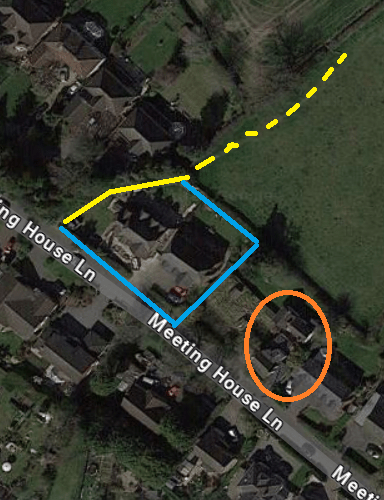
The cottage we will call Butler Cottage (blue plot) stood for around a century on Meeting House Lane a little to the north-west of Rose Cottage (orange circle) and adjacent to a footpath that survives today (yellow line). We know indirectly that the cottage was built on the waste some time before 1782, perhaps by its first recorded residents Samuel and Ann Butler, and was demolished in 1871. From 1835, it was part of the Bates estate along with neighbouring Rose Cottage, Laburnum House and Emscote.
Early Years: the Cottage on the Waste
The first evidence I’ve found of Butler Cottage is on the Berkswell Enclosure map of 1802. One of the objectives of the Enclosure Act was to regularise the proliferation of unauthorised cottages that had been built on the parish’s wastes and common land and bring them into the ownership of Berkswell Manor. Butler Cottage is included in the ‘first list’ of cottages which had existed for at least twenty years, so we assume that it had been built before 1782.
The residents of Butler Cottage at the time of the Enclosure Act were Samuel and Ann Butler. Ann (nee Lawrence) was Samuel’s second wife; they had married at Hampton in Arden in 1792, both giving their residence as Balsall.1 Ten years later, Samuel is listed on the Enclosure Map as occupier of Butler Cottage (no. 31), described as a ‘Cottage and Garden at Balsall Common’. Its plot of 15 perches was the smallest of all the newly regularised cottages.
Samuel Butler died during the enclosure process and was buried at Berkswell Church on 23 February 1803. Ann remained at the cottage until her own death in 1825, when she joined Samuel in Berkswell churchyard.2
Later Years: the Bates Estate
In August 1835, ten years after Ann Butler’s death, the Lord of Berkswell Manor sold Butler Cottage, described as ‘cottage or tenement with garden adjoining and belonging near Balsall Heath, formerly occupied by Ann Butler, widow,’ to William Rotherham for £110.3 Rotherham was the friend and adviser of Susannah Hiatt and between them they had bought up much of the surrounding land and property, including Rose Cottage, Emscot, and the site of Susannah’s newly-built family home, Laburnum House. Three years later, Rotherham sold the cottage along with neighbouring Rose Cottage and the surrounding fields to Susannah’s granddaughter Mary Ann Bates.4
The tenant when Rotherham bought the cottage in 1835 was Thomas Hiatt (1785-1866), who may have been a distant relative of Susannah Hiatt. He was a Berkswell native, one of the 18 children of the farmer William Hiatt and his wife Hannah Kelsey. The 1839 Tithe Apportionment records Thomas Hyatt [sic] as occupier of no. 953, a cottage and garden on a plot of 15 perches, owned by Mary Ann Bates. The 1841 census shows Thomas as an agricultural labourer, living at the cottage with his wife Ann.
Home to a Murderer
Ann Hiatt and Butler Cottage briefly came to public notice in November 1845, when one of Ann’s former lodgers, a young man called James Read, was accused of murder. Ann’s evidence, summarised in the local newspaper, recorded that she:
lives by the side of the common, in Berkswell parish, at a short distance from where the murder was committed; is in the habit of taking in lodgers; James Read came to lodge at our house on the first Monday in July; he found his own mending, and I washed for him.5
James Read was a local labourer, aged just 18. He stayed with the Hiatts from July to November 1845, leaving a week before the murder, although he returned a few days later in the middle of the night and:
let himself in by throwing up the sash … he took a work-box which I had been in the habit of putting my money in, but there was not any money in it when it was took and I found it in the privy’.6
Read was subsequently acquitted of murder, but found guilty of larceny and transported to Tasmania.
The Cottage’s last years
By 1851, Thomas and Ann Hiatt had moved to Berkswell village. The new tenant of Butler Cottage was William Parker (1798-1879), a widowed farm labourer and another Berkswell native. He was still there at the time of the 1861 census, but by 1871 he had moved up the road to one of the three tiny dwellings at Emscot. The last recorded tenants of Butler Cottage, who appear on the April 1871 census, were William and Mary Baldock, with their three children. Like his predecessors, William was an agricultural labourer, and he and Mary were both Berkswell natives.
Less than a year after the 1871 census, in January 1872, Mary Ann Bates’s widower Henry Kimbell sold the cottage, along with neighbouring Rose Cottage and all the land, to a Coventry auctioneer. The Baldocks must have moved out very soon after the census in April, because our plot, still occupying 15 perches, is now described as ‘site of a cottage sometime since pulled down with the garden thereunto adjoining’.7
The site of Butler Cottage remained undeveloped until 1998, when two large detached houses were built; today’s 103a and 103b Meeting House Lane.8
Notes
- Marriages. Hampton in Arden, Warwickshire. 19 Aug. 1792. Samuel BUTLER and Ann LAWRENCE, both of Balsall. ↩︎
- Burials. Berkswell, Warwickshire. 23 Feb. 1803: Samuel BUTLER; 22 Sep. 1825: Ann BUTLER, widow, of Berkswell. ↩︎
- Conveyance of cottage and land at Berkswell from Sir JEE Wilmot to William Rotherham. 5-6 August 1835. Warks Record Office CR 2660/12. ↩︎
- Lease and release by William Rotherham of Coventry, printer and stationer, to Mary Ann Bates of Leamington Priors, spinster. 15-16 March 1838. Warks Record Office, CR2660/15. ↩︎
- ‘The Berkswell Murder,’ Coventry Herald, 28 Nov. 1845: 4. ↩︎
- ‘The Berkswell Murder,’ Coventry Herald, 28 Nov. 1845: 4. ↩︎
- Conveyance by Henry Deavol Kimbell of Knowle, chemist and druggist … to Denis George Barnes of Coventry, auctioneer and appraiser. 18 Jan. 1872. Warks Record Office, CR 2660/16. ↩︎
- Solihull Planning Portal. Application no. 98/0434. 30 April 1998. Land adj. 109 Meeting House Lane, Balsall Common. ↩︎
 Oldnall End One Place Study