
We can trace the history of the cottage now known as Emscot to the early 17th century, when it was a cottage with two fields (later divided into three), passing through several generations of the Wayte family, then purchased by Job Potter and bequeathed to his cousin Ralph Byfield. The Byfields eventually sold the cottage to another local family, the Dockers, and in 1826 the Dockers sold it to Susannah Hiatt along with the nearby land that would eventually become Laburnum House. For part of the 19th century it was divided into three small residences, before being restored as a single dwelling by the Elson family of Laburnum House. In 1988 it became one of Oldnall End’s Grade II-listed properties (read its listing here).
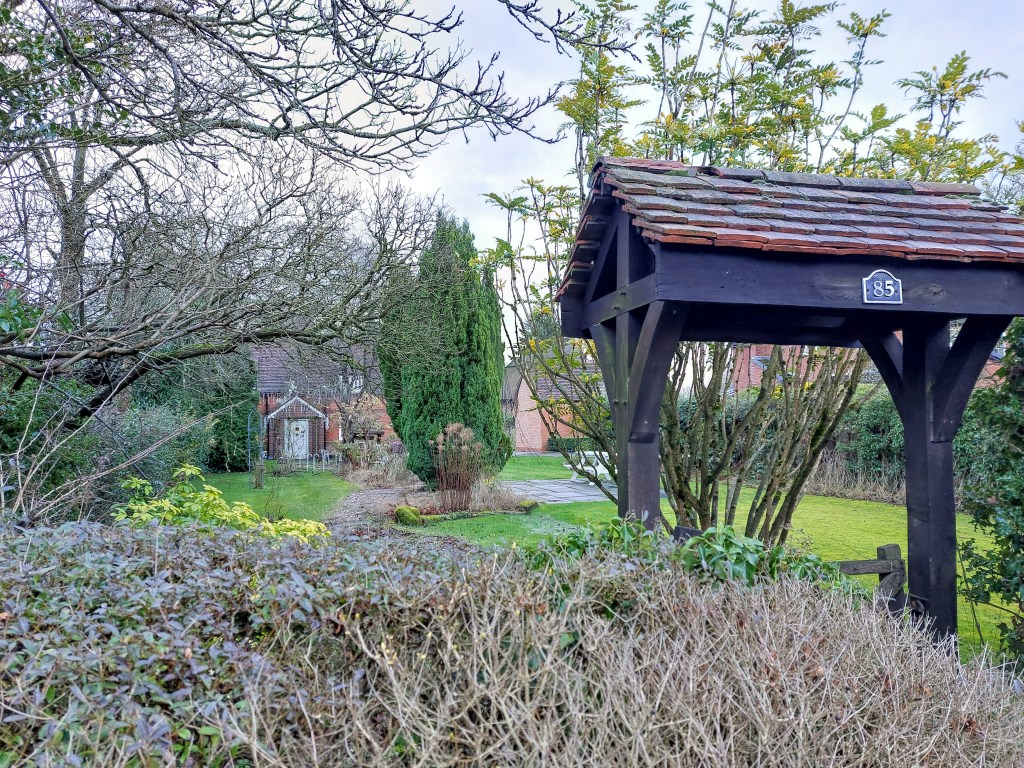
The depth of the front garden shows the original distance from the common.
An old estate
In December 1686 the Berkswell resident Job Potter, a retired Yeoman of the Guard, wrote his will, leaving three Oldnall End properties: today’s Sunnyside House and Emscot, and the cottage next door to Emscot whose subsequent brief stint as a Quaker Meeting House would give its name to the lane. Emscot and the next-door cottage went to Potter’s cousins, the weavers (and cousins) Ralph and Thomas Byfield. To Ralph, Job left
my cottage or tenement, that I lately bought of Peirson Waite & Anthony Glover … with Orchard, gardens & three closes of pastures, lying & being in Berkswell.1
Potter’s will takes the cottage’s history back another 35 years to 1651, when Peirson Waite and Anthony Glover (who was the tenant) inherited the messuage … with the orchard, garden and two closes of land in from their cousin William Fisher, who in turn had bought it from another cousin, William Wayte.2 It is possible that this is the same property William had inherited in 1621 from his father Francis Wayte, a weaver, who left ‘the lease of the house & grounds where I now dwell’ to his daughter Mary and her husband Anthony Glover.3 The presence of the Glovers as tenants in both 1621 and 1651 supports the idea that the three wills all refer to the same cottage.4
In 1713, almost 90 years after Francis Wayte made his will, Ralph Byfield and his wife Hannah mortgaged the cottage to a neighbour. The document tells us that the three closes were called the Home Close, Glovers Close (‘lately divided into two closes’) and the Further Close. The three closes still exist today between Meeting House Land and Barretts Lane in Balsall Common.

My drawing, based on an 1871 estate map

The names of the closes provide a little insight into the farm’s history. Home Close is so called because it sits next to the farm or homestead, and Further (later Far) Close because it is on the other side of Home Close. The names Home Close and Further/Far Close can be traced through subsequent deeds and documents until at least 1880. Glover’s Close was presumably named for the former tenant Anthony Glover, but this name did not survive. The lower section became ‘Whitening Pleck‘, perhaps because this is where the Byfields bleached the cloth they wove, while the upper section became ‘Far Lane Close,’ for its position alongside Barretts Lane.
Ralph Byfield junior died in 1746, and the probate inventory taken by his sons in law and a neighbour provides an insight into the cottage and its contents at this time.5 There were 4 or 5 dwelling rooms, alongside a weaver’s shop, a brewhouse and a ‘watchhouse’. The kitchen was the main room for cooking and eating, with tools for both alongside a ‘dresser of drawers’ and six chairs. The parlour was a more formal room, with a clock & case, a chest, a chair and a ‘court cubbord’. The buttery was used for cheesemaking and baking, while the shop contained all Ralph’s weaving tools: spinning wheels, looms, gears, as well as a cheesepress and a pigtrough. Upstairs, the kitchen chamber was used for sleeping and storing flax and linen, while the parlour chamber6 had two beds, one of which belonged to Ralph’s daughter Mary, along with all her bed and table linen and another six chairs.
Enclosure and Expansion
The Byfields eventually sold the farm to the Docker family, who owned a great deal of property in Oldnall End and had given their name to Docker’s Lane (now Station Road). By 1804, William Docker was farming at the cottage and took advantage of the Enclosure Award of 1802-1808 to expand his estate. He purchased two ‘old encroachments’ (meaning land he had already reclaimed) in front of the cottage and two new enclosures (meaning newly reclaimed land) on the common across the road. The extent of the old encroachments can still be seen today in the cottage’s very long front garden. Docker sold the farm in 1826 to Susannah Hiatt and from hereon in it was absorbed into the larger estate occupied by the Hiatt, Bates and Elson families.
A Cottage Divided
By the time of the Berkswell Tithe Apportionment in 1839, the closes had been absorbed into the larger estate farmed by Susannah Hiatt’s grandson Henry Hiatt Bates. Meanwhile, the cottage had been subdivided into ‘three cottages and gardens’ occupied by an ag lab, a carpenter, and a milliner. By the time Bates advertised his estate for sale in 1870, the cottage was still subdivided into one-up one-down dwellings and rented to three ag labs. The newspaper advertisement noted that:
Each of the houses occupied by William Parker, George Wooley and George Clayton, comprises large kitchen, pantry, coalhouse, chamber, and there is a large garden and necessary outbuildings.7
The cottage seems to have been unoccupied at the time of the 1881 and 1891 censuses, and then restored as a single-family dwelling. When the estate was sold off after the death of Fred Elson in 1940, it was described as ‘a detached old-world cottage, known as The Cottage’.8
Notes
- Will of Job Potter of Berkswell, Yeoman. 6 Dec. 1686. Note: although Job’s occupation was given as ‘Yeoman’ (landowning freeholder), this is separate from his role as a Yeoman of the Guard to both Charles I and II. ↩︎
- Will of William Fisher of Berkswell, tailor. 16 September 1650. ↩︎
- Will of Francis Wayte of Berkswell, weaver. 8 Mar. 1621. Probate 21 May 1621. In a neat coincidence (and one which supports the identification of this cottage with the one purchased by Potter before 1686), one of the witnesses of Francis’ will was Job Potter’s stepfather Thomas Hooke. ↩︎
- The Anthony Glover who was tenant in 1621 and 1651 was likely the father of the Anthony Glover, labourer, who was buried at Berkswell in 1687. ↩︎
- Probate inventory of Ralph Byfield of Berkswell, weaver. 7 Apr. 1746. ↩︎
- The inventory lists a parlour, then several other rooms, and then another parlour. My hypothesis is that the second parlour is actually a ‘chamber over parlour,’ but this is not certain. ↩︎
- Coventry Standard, 23 Sep. 1870: 1. ↩︎
- Coventry Standard, 14 Sep. 1940: 6. ↩︎
 Oldnall End One Place Study