

This farm was the largest property in Meeting House Lane. We have records of parts of the estate as far back as the 1730s, but the farm was developed and expanded by the Reader family, who took over in the 1780s and farmed it for more than 90 years. In 1839 it covered the area marked in red on the map (Google Maps). Known by the 1880s as Meadow House Farm, it survived until the 1970s when it was replaced by seven modern detached houses.
Early Years: Byfield and Cross
The earliest records that relate to this farm are from the Berkswell Court Rolls, when the Byfield family transferred some copyhold property to their neighbours, the Cross family.1 That property can be traced through Court Rolls to William Reader’s purchase in 1785,2 and then through Land Tax until 1830.
The Byfields who leased this property from the Manor were Thomas and Sarah Byfield, the tenants of Sunnyside House on Barretts Lane. They were part of the sprawling local family that included Thomas’s older brother Ralph and their cousin Thomas, who also lived on Meeting House Lane. It isn’t clear whether Thomas and Sarah’s copyhold estate included a farmhouse; we know from other sources that their home was at Sunnyside, so this may simply have been additional farmland. After Thomas’s death in 1731, Sarah and their son William moved to Kenilworth and had no further use for their Berkswell properties. At the Manorial Court of 1736, they transferred their copyhold land on Meeting House Lane to Joseph and Mary Cross.
Joseph and Mary (nee Walker) were both from large Berkswell families, although they themselves had no children. Joseph, a weaver, died in 1761 and Mary in 1768. In her will, Mary left my messuage and copyhold lands in the Manor and Parish of Berkswell now in the tenure of John Gardner, to her great nephew Thomas Downes, grandson of Joseph’s younger brother John.3 The wording of Mary’s will suggests that by 1768 there was a freehold farmhouse on the site alongside the copyhold land, all of it tenanted by John Gardner. According to Land Tax records, Gardner stayed at the farm until 1782.
The Reader Family, 1783-1871
In 1783, Land Tax shows a new tenant at the farm: William Reader. He and his wife Mary (nee Holmes) had married at Wroxall in 1782 and arrived at the farm as newlyweds. They did not remain tenants for long; the Berkswell Court Roll for 1785 records Thomas Downes surrendering the estate to William Reader.4 William was not only a farmer, but a weaver and whitener, using the land to grow flax and to bleach the cloth he wove.5
William and Mary returned to Wroxall in 1792 and let the farm out, first to their neighbour John Kelsey (Land Tax, 1795-8) and then to John and Mary Hammond (Land Tax, 1800-1810). The 1802 Enclosure Map shows the extent of the farm at this time (marked in blue), when Reader acquired a new enclosure to the south of the lane. Between 1802 and 1810, Reader purchased additional land to the north (including the site of the Moe House) from the Barratts of Sunnyside. The farm had now reached its maximum size (marked in red on the Tithe and contemporary maps).
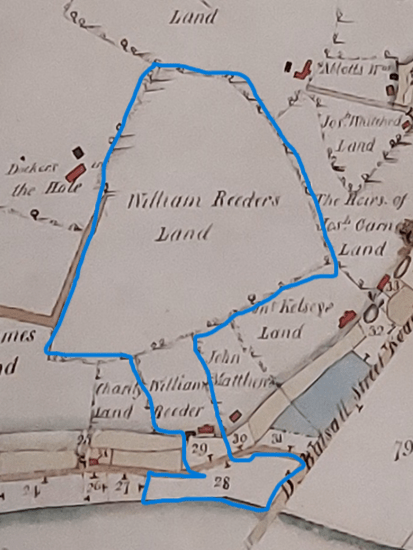
(Warwick Archives)
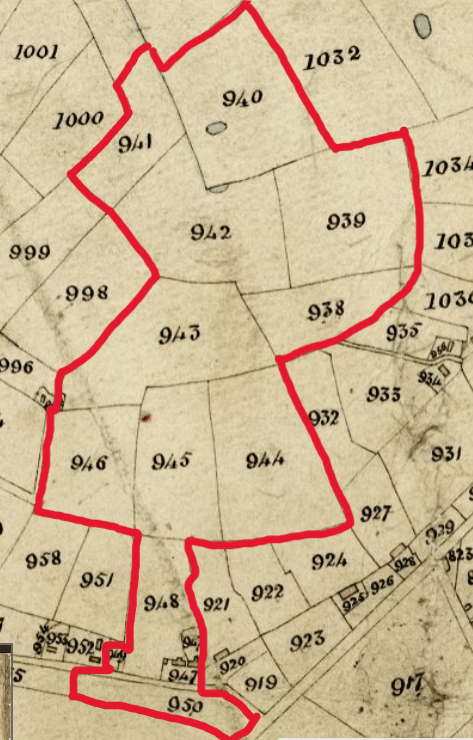
(Warwick Archives)
In April 1811, William and Mary’s son Samuel Reader married Penelope Garner of Ram Hall and the newlyweds moved in to Meadow House Farm. At first they rented from William, but by 1830 they had purchased the farm from him (Land Tax, 1815-30). They had four children before Samuel died in 1831 aged just 45. His will, dated 6 May 1830, leaves Penelope all my Freehold and Copyhold piece or parcel of land … near to the Windmill on Balsall Common in my own occupation.6
The Berkswell Tithe Apportionment of 1839 records Penelope Reeder as the farm’s owner-occupier. Along with the Homestead & Garden (947), her estate included 11 fields and crofts adjacent to the farm, plus an allotment near the Windmill (827) and a pasture near Redfen Farm (872). The 1841 census shows her living on ‘Berkswell Common,’ a 50-year-old farmer with her two younger sons Mark and William and two servants, William Hammond (who had lived on the farm as a child) and Hannah Smith.
During the 1840s, Penelope’s second son Samuel and his wife Rebecca took over the farm, and Penelope moved to Green Hill Farm in Harbury with her youngest son William. Although Samuel and Rebecca stayed at the farm until 1871, they seem to have struggled to manage it. They put the farm up for sale in 1848, when it was described as a ‘valuable FREEHOLD FARM, situate at Oldnall End,’ with ‘a good House and well-arranged Farm Buildings … an opportunity for Investment rarely to be met with’.7 Within a year, Samuel had declared bankruptcy, but it seems he held on to the farm with the help of his Trustees.
In September 1870, Samuel advertised the contents of the house and farm for sale, including:
an assortment of HOUSEHOLD FURNITURE, two powerful draught horses, milch cows, Guernsey calf, ten acres of grass-keep till Lady-day, three-quarters of an acre of potatoes, one acre of turnips, three acres of clover and seed keep, three porket pigs, dairy utensils, timber carriage, iron scuffle, and other effects.8
The reason for this sale was that family had decided to emigrate. The census of 2 April 1871 records Samuel, Rebecca, their daughters Fanny and Harriet, daughter in law Martha and grandson William still at Meeting House Lane. It looks as if they were waiting for a new grandchild, because on 31 August 1871, the six of them plus newborn Rebecca arrived at New York aboard the Idaho from Liverpool. They were en route to join Samuel’s older brother Thomas and son Samuel junior in Benton County, Oregon.
After the Readers
The buyer at the 1870 sale was Thomas Walker, the Lord of Berkswell Manor, and it seems to have been under his ownership that the farm gained the name Meadow House Farm. After Walker’s death, the farm was put up for sale in 1888, when it failed to sell, and again in 1890. Throughout this period the farm’s tenants were Thomas and Catherine Painting. Thomas was from Rowington, but Catherine (nee Adkins) had grown up in Truggist Lane. The Paintings stayed until Catherine’s death in 1899, when Thomas gave up the tenancy and the farm was sold on. The sales advertisement described the buildings as ‘in very good repair, having lately had a considerable amount expended upon them’,9 and the farm was sold for £1,950 (the equivalent of around £152,000 today).10
The tenants in 1901 were Thomas and Sarah Smith, and in 1911 Henry and Mary Ann Smith, although the two families seem not to have been related. The ‘exceptionally choice freehold pleasure or dairy farm’ was advertised for sale again in 1919, when the tenant was Mr H Darlow.11 The advert describes the farm as comprising:
A Substantially-built Brick and Tiled COTTAGE RESIDENCE containing: Two Sittingrooms, Kitchen, Scullery, Dairy, four capital Bedrooms, and Cheeseroom, and having a pleasant Garden, conveniently arranged FARM BUILDINGS and ELEVEN FIELDS of rich well watered PASTURE and MEADOW LAND, the whole having an area of about 39A 3R 2P.
The farm was eventually sold in 1921 to Mr GE Bird, a Coventry butcher, who lived there until his death in 1950. After many years of failed planning applications, Solihull council granted outline permission for homes to be built on the site in the mid-1970s.12 Today the site of Meadow House Farm’s farmhouse and buildings lies beneath nos. 111-123 Meeting House Lane.
Notes
- Berkswell Court Roll. 28 Mar / 12 Apr. 1732; 13 Apr. 1736. Warwickshire Archives. ↩︎
- Berkswell Court Rolls. 30 Mar. 1785. Warwickshire Archives. ↩︎
- Will of Mary Cross, widow, of Berkswell. 29 March 1768. Probate Lichfield 1 July 1768 to John Floide and James Stanbury the Younger, Executors. ↩︎
- Berkswell Court Roll. 30 Mar. 1785. Warwick Archives. ↩︎
- ‘Hemp and Flax Claims.’ Aris’s Birmingham Gazette, 28 Sep. 1789: 4. ↩︎
- Will of Samuel Reader of Berkswell, farmer. 6 May 1830. Probate Coventry 7 Oct. 1831 to Thomas Reader (brother) and Thomas Reader (son). ↩︎
- ‘Berkswell, Warwickshire. Valuable Freehold Farm.’ Coventry Standard, 15 Dec. 1848: 1. ↩︎
- ‘Waste Lane, Berkswell.’ Coventry Standard, 9 Sep. 1870: 1. ↩︎
- ‘Lot 1,’ Coventry Herald, 6 Oct. 1899: 4. ↩︎
- Coventry Evening Telegraph, 18 Oct. 1899: 3. ↩︎
- ‘Edwards, Son, & Bigwood,’ Warwick Advertiser, 6 Sep. 1919: 5. ↩︎
- ‘Home Plan,’ Coventry Evening Telegraph, 30 Sep. 1976: 26. ↩︎
 Oldnall End One Place Study