

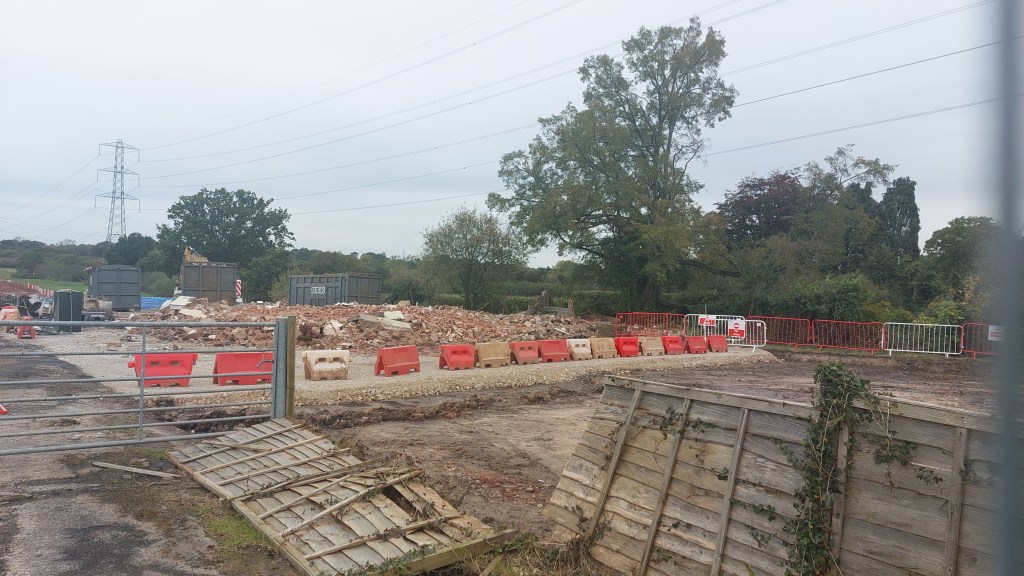
Odnaull End Farm has its origins in a sprawling copyhold estate first recorded in 1553. By 1802 (and perhaps much earlier), a small cottage had been built in a corner of the property, which eventually grew into a farm with two or three fields of its own. The name Odnaull (or Odnell) End is an ancient name for this corner of Berkswell parish, but it probably wasn’t attached to the farm until the 1920s, perhaps by a resident with a penchant for history. After more than 200 years hidden away in its quiet corner of the parish, the farmhouse was demolished in October 2024.
Origins: The Mystery of Colliers Wells

The Berkswell Tithe Map of 1839 (left) shows Odnaull End as a cottage and garden (no. 1068) owned and occupied by William Cox. It sits in the corner of a long, almost L-shaped plot made up of its three fields: Long Close (1065), Meadow with Hovel (1066), and Colliers Wells (1067).
Left: Berkswell Tithe Map (extract). Warwickshire County Record Office.
It is the unusual name ‘Colliers Wells’ that enables us to trace the site’s history back almost another 300 years. In 1553, the Crown carried out a survey of Berkswell manor, which lists around 70 manorial tenants and their property.1 Among them was Richard Slough, who held a group of crofts with two groves ‘called Colyerswell, between Beachewood and Waste Lane’. 130 years later in 1686, the Manorial Court Roll records the transfer of six copyhold closes and pasture totalling 25 acres, and called Collyers Wells from John Whadcocke to the Perkins family.2
It seems that the field recorded as Colliers Wells in 1839 was the last vestige of the much larger Colyerswell of 280 years earlier. What does the name mean? Coal mining was not a local industry, so it is unlikely to refer to colliers in the modern sense, but it could commemorate a previous owner with the surname Collier. Or does the association go back further? Collier itself is an occupational surname, originally referring to somebody who made charcoal. Could this partly wooded site, with Slough’s two long-vanished groves, once have been used for charcoal making?
Enclosure and Tithe, 1783-1839
By the late 18th century, the groves were gone and a small cottage had been built in the corner of the property. William Cox, the owner-occupier in 1839, did not live in the cottage; he was the tenant at the adjacent (and much larger) Beechwood Farm. Twenty years earlier, he had rented the cottage, described as ‘a house and two fields called Top and Bottom Close‘ totalling 10 acres and then occupied by William Robinson from the estate of Thomas Woodward, along with ‘four fields called Barrs Meadow, Collyers Wells, Barrs Land, and Long Close‘ totalling 16 acres and occupied by Samuel Taylor.3
The names of Barrs Meadow and Barrs Land commemorate a former owner of the property. Edward Barr was a yeoman farmer, who is recorded as the owner on Land Tax records for 1783 and 1785. When he died in March 1785, he directed his copyhold messuage and three pieces of arable meadow or pasture land, which he himself occupied, to be sold and the proceeds split between his unmarried sister Mary and a kinswoman called Hannah Dakan Shaw.4
I haven’t yet located a sale for the property after Barr’s death, but by 1795 it was in the hands of a local farmer called Thomas Woodward. The following year, the Court Roll shows that he surrendered a messuage and two closes adjacent to Western Heath, Nailcote End [sic] to his son, Thomas Woodward the Younger. On the Enclosure Map of 1802 (right; Warwickshire County Record Office), the younger Woodward is shown as owner of a long, twisting plot with a small cottage in the corner, identical in layout to the one owned by Cox in 1839.

On Woodward’s death in 1819 his trustees rented the property to Cox, as we have seen. When they finally decided to sell in October 1839, Cox bought the cottage, garden and two pieces of Copyhold Meadow and Arable Land (Great Meadow and Long Close), along with the copyhold arable land called Blacksmith’s Piece, whose area of 4A 1R 39P allows us to identify it with Colliers Wells.5 The rest of the fields Cox had rented were bought back by the Hurst family, from whom Woodward had acquired them in 1817.6
Mysterious heirs and a Bigamist, 1841-1872
William Cox died in Berkswell on 11 October 1844, aged 71.7 He left his tenancy of Beechwood Farm to his wife Mary and then to Mary’s granddaughter Elizabeth and her husband Richard Dormer. The messuage, tenement and garden in the occupation of John Cranmore and also the cowhovel near thereto in my own occupation together with all my three closes … lying near the said messuage and called … The Long Close, The Great Meadow and The Broom Field,8 he left to a young woman called Mary Eliza Arch, ‘the natural daughter of Ann Arch of Barford, milliner’.9 No explanation of their relationship is given.
Cox’s tenant in 1844, John Cranmore, was a former soldier from Meriden, now working as a bricklayer who is the subject of a very unusual note in the Berkswell burial register for 1821. Beside two entries for ‘Charlotte, wife of John Crammer Junr’ and ‘Sarah, wife of John Crammer Junr’, made two days apart, the Rev. Thomas Cattell has written:
NB This man had two wives; to one he was married at Chatham & the other at one of the Churches in Coventry. Both wives were living at the same time.10
Six months after the deaths of Charlotte and Sarah, Cranmore married his third and final wife, Ann Parmer; the 1841 census records them at Odnaull End with their three young sons.
After Cox’s death, the Cranmores moved down the road and the mysterious Arches moved in. The 1851 census shows Hannah Arch, an unmarried farmer of 16 acres from Barford, living with her daughter ‘Eliza’, a 17-year-old dairy maid, an elderly uncle called Edward Arch, and a 27-year old farm servant called John Clark. Eliza married and moved out, but Hannah was still at the farm in 1871, although she seems to have moved to Balsall shortly before her death the following year.11 Hannah Arch never married, perhaps because of the clause in William Cox’s will that said she could keep the farm as long as she remained single.
Later Years
The smallholding was home to several families over the years, including the Thompsons, Bennetts, Frosts, Cotons and Simpsons, and is first recorded as ‘Odnell End Farm’ in 1929, when the residents were dairy farmers Sydney and Florence Simpson.12 During the 1970s and 1980s it was the family home of Olympic showjumper Nick Skelton.
The field that was the last remnant of the 16th-century Colyerswell is now the site of an HS2 compound. Odnuall End farmhouse survived on the very edge of the site until 9 October 2024, when it was demolished for the construction of a new road bridge.
Notes
- Berkswell Manor, Survey. 1553-1554. The National Archives E 36/167 ff.19-27. ↩︎
- Berkswell Court Roll. 13 Jan. 1686. Warwickshire Record Office MR 21/7. ↩︎
- Lease. 25 March 1819. Coventry Archives PA 47/71/1. ↩︎
- Will of Edward Barr of Berkswell, yeoman. 14 November 1784. Probate Coventry 13 October 1786. Lichfield Consistory Court. ↩︎
- ‘Sale of Thomas Woodward’s Estate.’ Leamington Spa Courier, 12 Oct. 1839: 3. ↩︎
- Berkswell Court Roll. 9 Apr. 1817. ↩︎
- ‘Deaths.’ Coventry Standard, 11 Oct. 1844: 4. ↩︎
- The Broom Field appears to be yet another alternate name for Colliers Wells. ↩︎
- Will of William Cox of Berkswell, farmer. 29 Feb. 1844. Probate Lichfield, 12 Feb. 1845. Lichfield Consistory Court. ↩︎
- Cranmore had indeed married Charlotte Wright on 5 Dec. 1808 at St John the Baptist Coventry; their son John was baptised at the same church on 2 Jan. 1809, and John senior enlisted in the 15th Regiment of Foot a week later. He spent almost ten years in the Army, including four years in India. On 12 September 1818, three days before he was discharged from the Army, he married Sarah Rankin at St Mary’s in Chatham. ↩︎
- Burial of Hannah Arch of Balsall, age 75. Hampton in Arden. 12 Dec. 1872. ↩︎
- ‘Defendants summoned…,’ Coventry Evening Telegraph, 23 Jul. 1929: 2. ↩︎
 Oldnall End One Place Study