
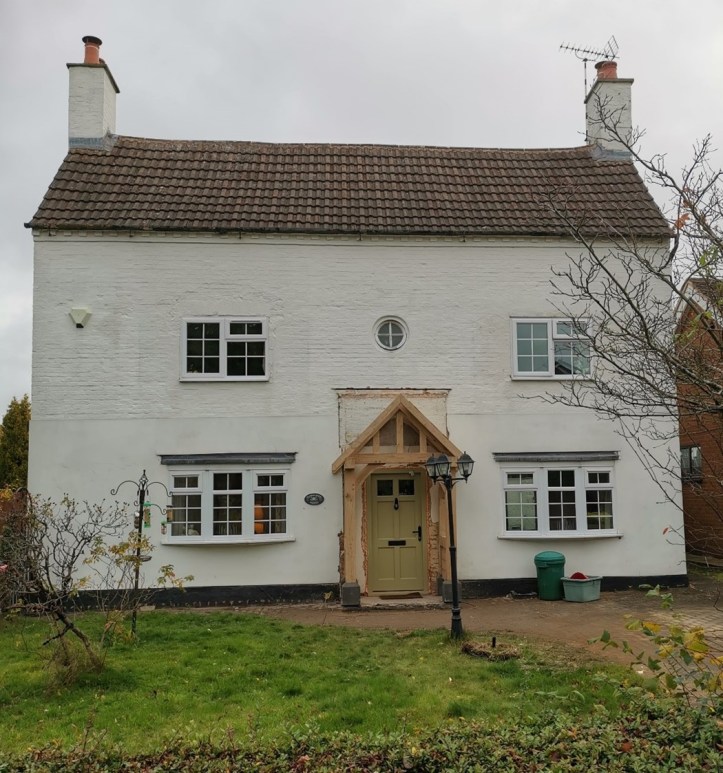
Sunnyside House has stood for almost 300 years at the corner of Sunnyside Lane and Barretts Lane. The youngest of the four historic farmhouses stretched along the east side of Barretts Lane, Sunnyside House was built in 1732 on the site of a much older property. Locally distinctive for its three-storey, brick construction, it has had many identities during its three centuries, from prestigious new-build to family farmhouse, gentleman’s residence, tied accommodation, investment property, and even the scene of a notorious Victorian murder.
Summer 1732: from Old to New
Sunnyside House was built in the summer of 1732 at the instruction of William and Mary Halsted, a clergyman and his wife from Buckinghamshire. It occupies the site of a much older property, which William and Mary had inherited from Mary’s mother, Mary Boucher Brideoake, on their marriage in 1723. Thanks to a protracted Chancery dispute with Mary’s brother Elihu Brideoake,1 we know many details of Sunnyside’s planning and construction.
The old house inherited by the Halsteds was a sprawling farmhouse once owned by Job Potter, a yeoman of the guard to Charles I and II, who had returned to his native Berkswell, where he died in 1686. Tenanted for many years by the Byfield family, it was described in the Chancery papers as ‘in a very ruinous bad state & condition … & of very little value so bad that [it] was absolutely necessary to be pulled down & rebuilt’. The death of the current tenant, Thomas Byfield, in 1732 allowed the Halsteds to proceed with the works.
The Halsteds’ intention was to create a modern investment property. They brought a carpenter from Buckingham called Richard Collins to design the house and to employ local craftsmen to carry out the construction, and appointed Berkswell resident John Paynter to project manage and liaise with the on-site carpenter, William Thompson. The demolition of the old house and construction of the new house began in July 1732, and the total cost was £24. The three-story construction is unusual for the area and would have made quite a statement when it was built. Even today, with modern development in between, the south wall and chimney are visible from as far away as Kelsey Lane.

(it’s the white building centre of photo!)
Paynters and Barretts
The Halsteds did not enjoy their investment for long, selling the house on to John Paynter the project manager, who continued to let it out to local tenant farmers. When he wrote his will in October 1767, he left his wife Elizabeth three properties, including ‘a messuage with the barn, stable, outhouses, and orchard, garden and inclosed land, which I purchased of the Reverend William Halsted and Mary his wife’.2 After the early death of John and Elizabeth’s son John junior, the whole Paynter estate came into the hands of the Paynters’ daughter in law Catherine, who in a neat twist of fate was the grand-daughter of William Thompson, the carpenter whom Paynter had commissioned to build the house for the Halsteds half a century earlier.
In 1789, Catherine Thompson Paynter remarried at Berkswell Church to Thomas Barratt or Barrett, a widower from a village near Rugby. This marriage would have a lasting impact on the local street map, as the Barratts gave their name to the track running in front of the house, which by the time of the 1841 census had become formally known as Barratts Lane, the name it retains today. The Barratts initially lived at the old Paynter homestead on Truggist Hill, but by 1807 they had moved to Sunnyside. In 1815 they put the estate up for sale, described as a ‘VERY desirable FREEHOLD ESTATE … consisting of a good and substantial DWELLING HOUSE, Yard, Garden, Barn, Stable, and necessary Outbuildings’.3

Copy of an original in private hands supplied to Berkswell & District History Group
Victorian Lives … and Deaths
With the departure of the Barratts, the house entered a new era in which it would change hands frequently, and sometimes unexpectedly. In 1833 it was bought by a middle-aged farmer called Thomas Tranter, who lived there alone for the next twelve years until one November morning in 1845 he was found dead in his brewhouse with a vicious wound to the head. The ‘Berkswell Murder,’ as it became known, caught the attention of the local and national press, who eagerly followed the pursuit, capture, trial and eventual, contentious acquittal of the only suspect, a young local man called James Read.4
After Tranter, the house was owned successively by the Kenilworth farmer Elizabeth Hicks (1845-1857) and the Birmingham merchant Alfred Smith Evans (1857-1870), both of whom let it out. During Evans’ ownership, the house was extended to the rear, with a new modern kitchen and a bedroom above, while the adjacent cottage was converted into servant accommodation and a laundry. The most longstanding tenant in this period was William Freer (1859-1867), the retired co-owner of Duddeston Hall Asylum. The extensive sales listing of household goods after his death in 1867 shows he had furnished the house as a Victorian gentleman’s country residence, with new mahogany and leather furniture, expensive carpets, fancy bedroom sets, and gaming tables. He also kept a small pleasure farm, with a handful of cows and pigs.5
In 1871, Sunnyside came back onto the market after Evans’ death. Described as ‘a delightfully-situated … Valuable and Improving Small Freehold Estate’,6 it was purchased by Thomas Walker, owner of the Berkswell Estate, who tenanted the land and turned the house into a grace and favour residence for senior estate staff. One of these staff, in residence from 1876 to 1881, was William Evans, a solicitor and Steward of Berkswell Manor who would later negotiate the purchase of Kenilworth’s Abbey Fields for use as a public park.7
Commuters and Catholics
Thomas Walker’s sudden death in 1888 brought Sunnyside back onto the market. Now described as ‘a Charming Pleasure Farm … desirably situate a few minutes from the Berkswell Station‘,8 it was purchased by a Birmingham brassware manufacture called Joseph Nicklin. He let the house to a series of fellow Birmingham professionals and their families, making the most of the proximity to the station. At this point, the house was briefly known as Fearn Cottage.
In 1909, elderly farmer’s widow Jane Price moved in with her two middle-aged stepdaughters Fanny and Bertha. The Prices let out part of the house to professional lodgers, who had a bedroom each and shared use of a sitting room.9 Jane died in 1913 at the age of 95, but Bertha Price lived at Sunnyside with a series of lodgers until 1937. Meanwhile, the farm estate was tenanted from 1891 until 1955 by the Rushton family, who lived in the adjacent cottage and who are remembered in nearby Rushton Close.
The Nicklins owned Sunnyside until 1945, when they bequeathed it to the Roman Catholic diocese of Birmingham. The Diocese built a small church in the corner of the Home Field and sold most of the land for development, giving us today’s Sunnyside Lane, Beverley Close, Rushton Close, and Oxhayes Close. The last remaining undeveloped part of the estate is the field previously known as Kendall Field and Jury Field and more recently as Meeting House Lane Park. Once open for community use, it is now fenced off and awaiting the outcome of a planning application.

Notes
- The National Archives. E 134/14Geo2/Mich5. ↩︎
- Will of John Paynter. 17 Oct 1767. Proved at Coleshill, 15 Apr. 1768. Lichfield & Coventry Consistory Court. ↩︎
- ‘The “Herald” in 1815,’ Coventry Herald, Apr. 1915. ↩︎
- Although acquitted of Tranter’s murder at Warwick Assizes, Read was quickly rearrested and found guilty on a charge of larceny, having pawned several items of Tranter’s clothing in the days after the murder. After five years aboard a prison hulk in Gibraltar, he was transported to Tasmania. ↩︎
- ‘Berkswell, near Coventry,’ Coventry Standard, 5 Apr. 1867: 1. ↩︎
- ‘Morning Sale,’ Coventry Herald, 26 May 1871: 2. ↩︎
- ‘The Spring.’ Victorian Kenilworth. https://www.victoriankenilworth.co.uk/the-spring/ ↩︎
- Sale of Outlying Portions of the Berkswell Estate, August 1888. Warwickshire Archives CR 1709/552/2. ↩︎
- Warwickshire Register of Parochial Electors 1911. Berkswell (Lodgers) – H 13. British Library SPR.Mic.P.611/BL.W.28.5 ↩︎
 Oldnall End One Place Study