
The brick and timber farmhouse that would become today’s Brickmakers’ Arms has stood on Docker’s Lane (now Station Road) since at least the mid-17th century. For almost 200 years it was home to successive generations of the Watson family, beginning with William (I) and Margery WATSON, who bought the farmhouse from a local gentleman named Henry HUGGEFORD at some point before Huggeford’s death in 1687.1 It remained the Watson family home until 1846, but within twenty years had been reinvented as the Brickmakers’ Arms pub.
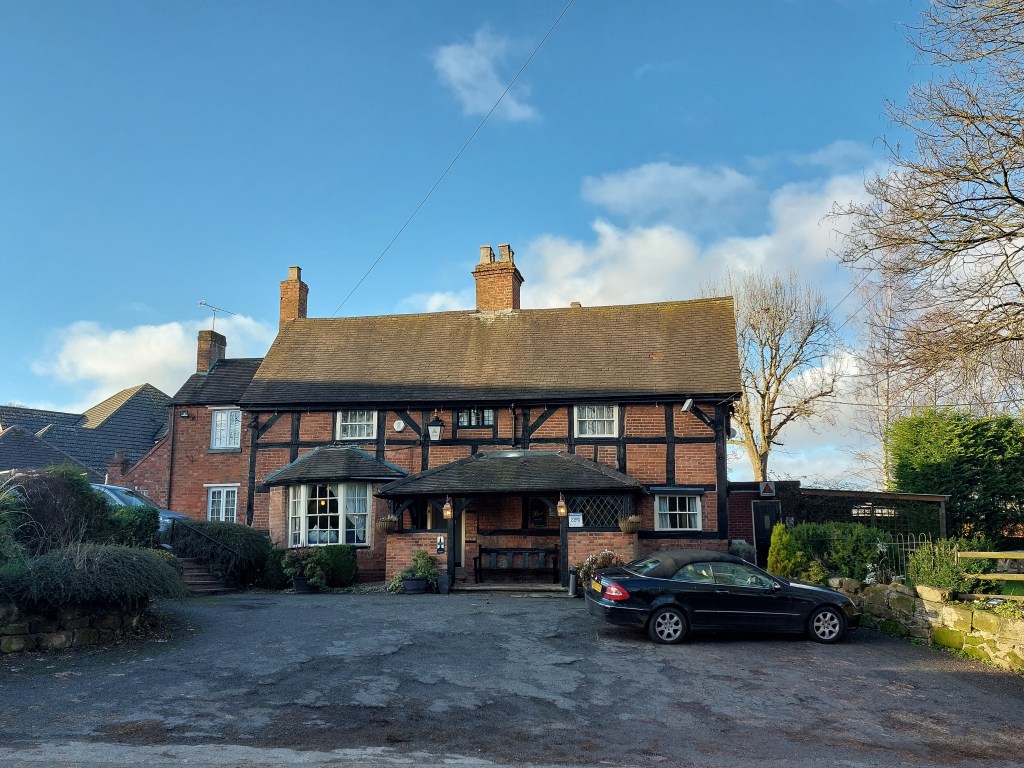

The Watsons first appear in Berkswell parish records in January 1653, when William (I) and Margery (I) baptised their eldest son, Henry (I). William and Margery would go on to have at least three more surviving children: twins William (II) and Margery (II), born in 1656, and Thomas (I), born ten years later. William began his career as a weaver,2 but by the time of his death in 1704 he had become a wealthy man, described in both his will and inventory as a yeoman.
The Second Generation
Margery (I) died in 1699 by which time all four of the Watson children were married: Henry (I), William (II) and Margery (II, mar. Levi Boughton) had all settled in Berkswell, while youngest son Thomas (I) had moved away to Hurst in the neighbouring parish of Stoneleigh. Although Thomas and Margery now had their own households, William’s farmhouse continued to be the main family home. Eldest son Henry (I) and his wife Elizabeth (nee Dobridge) had no children and may well have remained with William to help him run the house and farm, while second son William (II) and his family likely also lived there. On William (I)’s death in 1704, the house was probably home to William himself with Henry and Elizabeth, as well as to William (II) and his wife Sarah and their two small children William (III) and Margery (III).
By the time William (II) died in 1714 he and Sarah had three children: William (III), now 12; Margery (III), now 11, and Henry (IIb), now 7. He left no property but land, which supports the theory that he had remained in the family home, now owned by his brother Henry. They were certainly close; William charged Henry in his will with ‘breeding the children up till they come to the age of 21’. On Henry’s death in 1729 he left the house to his 18-year-old nephew Henry (IIb), instructing him to ‘allow unto Sarah his mother for & during her natural life, the use of such rooms … as she the said Sarah shall think fitt to use for her habitation’.
The Watson Estate
The farmhouse came with several closes of land, and the Watson family continued to expand their estate throughout the 18th century. William (I) purchased a close of pasture from his neighbour Henry DOCKER, which he left in his will to Henry (I), along with the farmhouse. William (I) also bought an as yet unidentified copyhold house with two closes in Oldnall End from Christopher BRADNOCKS in 1691, which he left to his son Thomas (I).
William’s grandson Henry (IIb) added to the estate, buying up property and land along Dockers Lane. By the time he made his will in 1766, he owned Cherry Tree Cottage, which he left to his son William (III), Manor Cottage, which he left to his son John (I), and a copyhold meadow in Oldnall End whose history can be traced back to 1657, which he left to his son Joseph.3 He had also bought two closes from his neighbour Gilbert DOCKER, which he left to his son Samuel.
By the time of the 1802 Enclosure Award, the Watson heirs had sold off all the properties except for the main family home. The Watson holdings were now consolidated in the lands immediately north and east of the farmhouse and would remain so until the final sale in 1846. We can see on the maps below how the coming of the railway in the 1830s split the estate in two.
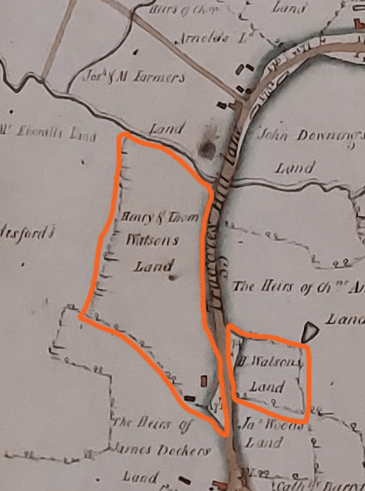

The 1839 Tithe Apportionment names the Watson fields as 1016 Oldnall End Piece (arable); 1264 Meadow below Railway; 1275 Meadow above Railway; 1276 Home Close (pasture), and 1278 Piece unenclosed, which later became a small green enjoyed by visitors to the Brickmaker’s Arms and today is the pub car park.
Five Generations of Watsons
The future Brickmaker’s Arms passed successively through five generations of Watson farmers, from William (I) to his eldest son Henry (I, 1653-1729), Henry’s nephew Henry (IIb, 1707-1766), Henry (IIb)’s sons Henry (III, 1735-1827) and Thomas (II, 1740-1811), and Henry (III)’s children Henry (IV, 1762-1825), John (II, 1763-1835), William (IV, 1765-1853) and Mary (1773-1857, mar. Abraham Lancaster). None of the fifth generation of Watsons had children, and so in 1846 when William (IV) and Mary became too old to continue with the farm, they sold up and moved to Balsall, where William died in 1853 at the age of 88 and Mary in 1857 at the age of 84.
- Click here to read a blog about the last generation of Watsons to live here!
- Click here to read a blog on what we can learn about the house from the Watson family’s probate inventories!
After the Watsons
It is unclear who owned the property immediately after the Watsons, but by 1868 it was home to a brickmaker called James JONES, who had moved to Berkswell from Leamington. The property was recorded as the Bricklayer’s Arms in November 1871,4 and as the Brickmaker’s Arms in May 1872,5 although it may have been operating as a pub for longer. Jones and his family gave the original farmhouse over to the pub, renting the adjoining house to a policeman’s widow, Elizabeth SHIPMAN, and building themselves a new villa called Ivydene in the corner of the grounds (now the site of Brickyard Close). They sold up and moved to Balsall in around 1879. The ‘Brickies’, as it’s familiarly known, has been a popular Berkswell pub ever since.
Before the Brickies: Timeline to 1846
| Date | Event | Source |
| bef 12 Sep. 1687 | William (I) WATSON purchases the property from Henry HUGGEFORD6 Note: this is the date of Henry Huggeford’s burial; presumably the transfer happened during Huggeford’s lifetime. | Will of William (I) WATSON, 1703 |
| 4 Mar 1703 | William (I) WATSON leaves house in Oldnall End & panel of enclosed land in 3 parts divided, purchased of Henry HUGGEFORD, dec’d, 1 close of pasture adjoining lately purchased of Henry DOCKER ==> eldest son Henry (I) WATSON Note: William (I) WATSON bur. Berkswell, 15 Jun. 1704 | Will of William (I) WATSON, 1703 |
| 21 Jun. 1704 | Inventory of William (I) WATSON’S property carried out by George LUGG, Gilbert DOCKER and Thomas WATSON: parlour, chamber, hall chamber, cheese chamber, cock-loft, parlour, hall, dairy & bolting house, stable, barn, cownhouse. Total: £730 13s 10d. | Will of William (I) WATSON, 1703 |
| 20 Feb. 1728 | Henry (I) WATSON, Senior of Barkeswell, yeoman, leaves messuage in Barkswell in my own occupation to his nephew Henry (IIb) WATSON, son of his brother William. Note: Henry (I) WATSON bur. Berkswell, 8 Sep. 1729 | Will of Henry (I) WATSON, 1728 |
| 6 Sep. 1729 | Inventory of Henry (I) WATSON’S property carried out by John PAYNTER and Edmund SAVAGE: parlour, hall, dairey, chamber over parlour, chamber over hall, cheese chamber, outside. | Will of Henry (I) WATSON, 1728 |
| 23 Jan. 1766 | Henry (IIb) WATSON of Berkswell, yeoman, leaves freehold messuage wherein I dwell and 2 meadows to sons Henry (III) and Thomas (II) WATSON as tenants in common. Note: Henry (IIb) WATSON bur. Berkswell, 2 Feb. 1766 | Will of Henry (IIb) WATSON, 1766 |
| 1773-5 | Owners: Henry & Thos WATSON | Land Tax |
| 1781-3 | Owners: Henry & Thos WATSON; occ. Wm WATSON | Land Tax |
| 1785 | Owners: Henry & Thos WATSON | Land Tax |
| 1795 | Owners: Henry & Thos WATSON; occ. Henry WATSON | Land Tax |
| 1802 | Owners: Henry & Thos WATSON | Enclosure Map |
| 1810 | Owners: Henry & Thos WATSON; occ. Henry WATSON | Land Tax |
| Jan. 1811 | Death of Thomas (II) WATSON Note: Thomas (II) WATSON bur. Berkswell, 23 Jan. 1811 | Parish Records |
| 9 Feb. 1811 | Administration of the estate of Thomas WATSON, a bachelor without parents, to brother Joseph WATSON of Cubbington. | Probate |
| 27 Jun. 1814 | Henry (III) WATSON leaves lands, goods and chattels to sons Henry (IV) and John (II) WATSON | Will of Henry (III) WATSON |
| 1815-1825 | Owner/Occupier: Henry WATSON | Land Tax |
| 11 Apr. 1827 | Henry (III) WATSON bur. Berkswell | Parish register |
| 27 Jun. 1827 | Probate of estate of Henry (III) WATSON | Probate |
| 1830 | Owner/Occupier: Henry WATSON (heirs) | Land Tax |
| 26 Sep. 1835 | Will of John (II) WATSON: all my freehold messuage or tenement to brother William (V) and sister Mary (Lancaster) WATSON. John (II) WATSON bur. 14 Oct. 1835, Berkswell Probate 8 Apr. 1836, Coventry | Will of John (II) WATSON |
| 1839 | Owner/Occupier: William WATSON | Tithe Apportionment |
| 6 Jun. 1841 | Dockers Lane: William WATSON. 75. Farmer. Y Mary LANCASTER. 60. Y | Census |
| Sep. 1846 | Sale of livestock, part of household furniture &c ‘upon the Premises of Mr WILLIAM WATSON, Docker’s Lane, Berkeswell’.7 Note: this is probably when William and Mary sold up and moved to Balsall. | Newspaper |
- The Berkswell Hearth Tax for 1662 and 1671 records William living in a house with four hearths, which subsequent probate inventories suggest wouldn’t be out of line for this property, although we can’t say for certain. ↩︎
- William is recorded as a weaver on the baptism of twins William and Margery at Berkswell, 21 November 1656. ↩︎
- The meadow can be traced through Berkswell Court Rolls from 1657 (Thomas MIDDLESTON sells to Samuel SAVAGE) until 1779, when Joseph & Margaret WATSON sold it to their neighbour Thomas SMITH and it was absorbed into Smith’s Truggist Hill estate. ↩︎
- Auction of 39,000 drain pipes … at Mr Jones’s, Bricklayer’s Arms, Berkswell. Coventry Standard, 24 Nov. 1871: 1. ↩︎
- ‘Desirable property at Berkswell [including] PUBLIC HOUSE, known as the “Brickmakers’ Arms”,’ Coventry Standard, 10 May 1872: 1. ↩︎
- Two potential properties appear on the Berkswell Hearth Tax: William WATSON, 4 hearths (1662, 1671); Mr Henry HUDGEFORD/HUGGFORD, Gent, 2 hearths (1663, 1671). Although it isn’t yet possible to say which of the properties corresponds to the future Brickmaker’s Arms, we might hypothesise that it is Watson’s larger property based on the size of the property as per his 1703 inventory. ↩︎
- [Auction announcement] Coventry Standard, 18 Sep. 1846: 1. ↩︎
 Oldnall End One Place Study