

This long-vanished pair of cottages were built before 1782 on encroachments into the common land to the east of Meeting House Lane. They stood within the orange area marked on the map, one on each side of the yellow line. Although they started life as two separate cottages, they were later divided into three, before being reconverted into a single dwelling. Today the site is occupied by numbers 55-67 Meeting House Lane.
Earliest records: the Cottages in 1802
Our first record of the two cottages is in the 1802 Berkswell Enclosure Act, where they are numbered 29 and 30 on the map of ‘old encroachments’ – meaning cottages illegally constructed on common land that had stood for at least 20 years (the cottage next door at no. 62, beyond the pond, was a ‘new encroachment’ less than 20 years old, and belonged to Francis Eaden). The Enclosure Act turned all encroachments into copyhold land of Berkswell Manor, making their occupiers manorial tenants.
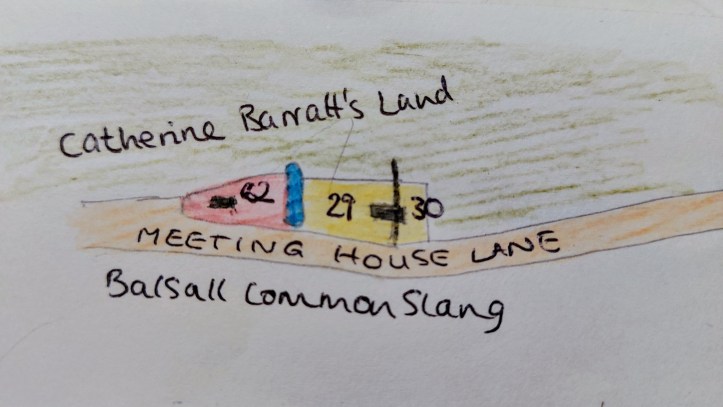
The Enclosure documents tell us that no. 29 was a Cottage, Garden and Croft at Balsall Common, covering two roods and occupied by John Scrivener. Scrivener, whose name was sometimes spelled Scribnor, was part of a large local family, many of whom were called John – so it is difficult to be sure which of the many John Scriveners is our man. We do know that he was a labourer, who died on 24th April 1838 of ‘age’ (he was 73) and was buried at Berkswell three days later.1 We know that the cottage was built before 1782, and Scrivener was born in around 1775, so he probably wasn’t the cottage’s original owner, but for now, its earliest years remain a mystery.
Next door, no. 30 was a Cottage and Garden of 35 perches, occupied by Timothy Corbett. His birthplace is uncertain, but in 1747, while working as a servant at Berkswell, he married Sarah White at Wormleighton, near the Oxfordshire border. The Corbetts settled in Berkswell, where they had six children, and perhaps built the cottage, which was certainly in place before 1782. Sarah died in May 1795, and three years later Timothy remarried at Sheldon to Martha Satton, who was about fifty years his junior. Timothy died in 1816 at the age of 96, leaving Martha the cottage.2
The Cottages in 1839 and 1841
Our next confirmed sighting of the cottages is on the Berkswell Tithe Apportionment of 1839, where they are described as ‘No. 968: Three Cottages and Gardens‘ belonging to Sir JEE Wilmot, the Lord of Berkswell Manor. Evidently, one of the cottages had been subdivided, a common practice and something that had happened up and down Meeting House Lane as housebuilding failed to keep up with local population growth (e.g. at Emscot, Rose Cottage, and the Bates Farm).
Although he died in 1838, the Tithe Apportionment records John Scrivener as occupying one of the cottages and the adjacent two-rood croft, now described as a Garden (no. 969 on the Tithe Map). This probably means the information for the Tithe Apportionment was collected over a long period and not updated before publication. The other two cottages, which the census implies were a division of the Corbett cottage,3 were occupied by Martha Corbett, widow of Timothy, and by Richard Thompson.
Martha Corbett survived her husband by almost thirty years and never remarried. She is recorded living alone at the cottage on the 1841 census as Martha Corbett, age 70. She died in 1845 at the age of 75 and was buried at Berkswell.4 Martha shared the cottage with Richard Thompson, whom the 1841 census records as an agricultural labourer aged 80, and Ann Thompson, aged 60. Richard was a member of the large local Thompson family and a cousin of Catherine Barratt (nee Thompson; 1753-1827), who gave her name to Barratts Lane. He and his wife Mary had four children before Mary’s death in 1824, but there is no record of Richard remarrying, so perhaps Ann was a cousin or another relative who had come to look after him. Richard Thompson died in 1848, aged 88, and was buried at Berkswell.5
The Parker Family, 1845-1894
The next family to arrive at the cottage converted it back into a single dwelling, which would be their home for half a century. Joseph Parker and Amey Green had married in Coventry in 1837 before returning to their native Berkswell, where they had 11 children between 1838 and 1859. After a short time at Westwood Heath, by the mid-1840s they had moved to Meeting House Lane, where successive censuses record them at the cottage with their growing family. Joseph started out as an agricultural labourer, but by the 1870s he was working as a carrier, transporting local produce in his cart as far afield as Coventry and Birmingham.

Amey died in 1879 and Joseph shared the house with various family members including his older brother John and his married daughters Alice Cooling (until a very public falling out) and Lucy Hadley.6 When the Berkswell Estate, which had owned the property since 1802, was put up for sale in 1888, the cottage was listed in the Sales Catalogue as no. 515, ‘a brick and thatched cottage of four rooms with stable and piggery‘, adjacent to no. 521, a ‘Grass Field‘ of 1R 39P, which corresponds to John Scrivener’s croft.7 Both were let out for a total of £7 to William Hadley, who was Lucy Parker’s second husband. Unfortunately William died a couple of months later at just 42,8 followed in March 1889 by Joseph, aged 76.9
As far as we can tell, the Hadley family were the last occupiers of the cottage. The 1891 census shows William’s widow Lucy Hadley (nee Parker) working as a charwoman, with her five children, aged between 3 and 15. Three years later, Lucy married her third husband, a local labourer called Thomas Wilkins,10 and the family moved a mile up the road to Beechwood.
The Site Today
No evidence has yet been found of the cottage’s precise fate, but it seems that the Hadleys were its last residents. The Ordnance Survey map of Berkswell for 1902 shows two detached houses standing on its site (no. 515), either side of a wide driveway that corresponds to the original border between the cottages and the croft. The croft or paddock (no. 521) is to the left.
Map reproduced with the permission of the National Library of Scotland

The left-hand property, Holly View, and the paddock were replaced after 1993 by modern detached houses (today’s nos. 55-65 Meeting House Lane, of which no. 65 is still known as Holly View House).11 The right-hand property, once a three-bedroom cottage known as Sandilands and now greatly extended, still stands as today’s 67 Meeting House Lane. Of the original cottages, no trace remains.
Notes
- Death Certificate. 24 April 1838. John SCRIVENOR of Balsall, Parish of Berkswell, age 73. ↩︎
- Burial. St John’s Berkswell. 12 May 1816. Timothy CORBET of Berkswell, age 96. ↩︎
- The 1841 census marks each inhabited house, and divides households within it. The Thompson and Corbett returns are included in the same house (building) but as separate households. ↩︎
- Burial. St John’s Berkswell. 25 March 1845. Martha CORBITT of Berkswell, age 75. ↩︎
- Burial. St John’s Berkswell. 27 Jan. 1848. Richard THOMPSON of Berkswell, age 88. ↩︎
- In November 1886, Joseph summoned his son in law William Cooling (husband of his daughter Alice) to the Coventry Petty Sessions for having locked him out of their shared cottage for coming home at 9pm. The Coolings appear to have moved on after this, and the Hadleys moved in. ‘Assaulting a Father in Law at Berkswell,’ Coleshill Chronicle, 4 Dec. 1886: 6. ↩︎
- ‘Sale of Outlying Portions of Berkswell Estate.’ August 1888. Warwick Archives. CR 1709/552. The identifying numbers used on the maps in the catalogue were taken from the Ordnance Survey. ↩︎
- Burial. St John’s Berkswell. 17 Oct. 1888. William HADLEY of Berkswell, age 42. ↩︎
- Burial. St John’s Berkswell. 23 March 1889. Joseph PARKER of Berksweell, age 76. ↩︎
- Marriage. St John’s Berkswell. 22 Sep. 1894. Thomas WILKINS and Lucy HADLEY. ↩︎
- Solihull Planning Portal. PL/1993/00392/FULL. Demolition of existing dwelling and replace with a four bedroom dwelling house. Approved 14 April 1993. ↩︎
 Oldnall End One Place Study