
I love house histories – researching them, writing them, reading them. In working on the history of my own house, I’ve found Gillian Tindall’s The House by the Thames and the People who Lived There and Fiona Rule’s The Oldest House in London especially inspiring, even though my house is both a long way from London and considerably younger than either Bankside or Cloth Fair. There is a difficulty in taking inspiration from these wonderful books, however, and that is that the level of detail they provide is both awe-inspiring and probably unachievable for your standard 18th-century Warwickshire farmhouse. Even so, inspiration has just taken the history of said Warwickshire farmhouse past 20,000 words – and we’ve only reached 1880!
So, this blog post is both an experiment and a test of discipline. I have chosen a completely different Oldnall End house and I am going to write a concise, blog-length history of it RIGHT HERE, RIGHT NOW.1
The Story of Manor Cottage
Manor Cottage is a neat red brick cottage on what was once Docker’s Lane, Berkswell and is now Station Road, Balsall Common. If you’ve visited Balsall Common and walked up the hill from the station to the village centre, you’ll have seen Manor Cottage on your left. Originally it was a small croft, with a cottage and garden, and two fields, situated to the left of the house as you look at it in the photo below.
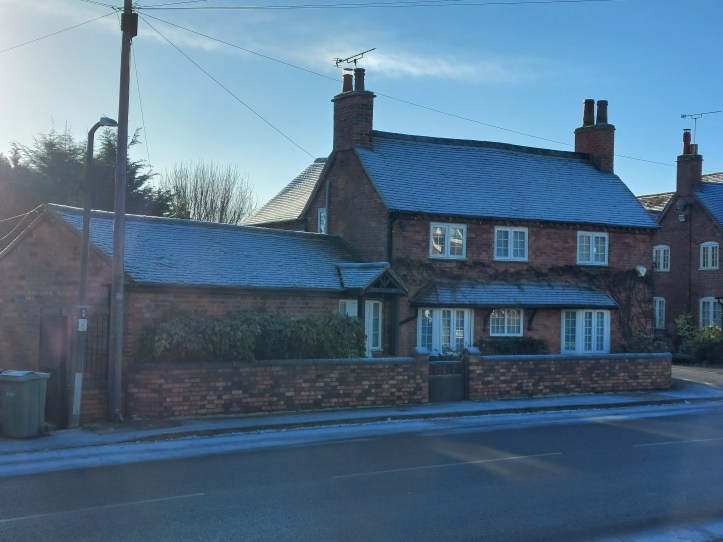
For much of its history, Manor Cottage was a copyhold property of Berkswell Manor, which meant that its ‘owners’ were formally manorial tenants and their tenants were formally sub-tenants. In practice, this didn’t make a great deal of difference to the owners, who could still sell the property or leave it to their heirs – but it’s very helpful for us as researchers, because all of these transactions were entered into the Berkswell Manorial Court Books, which are now held at Warwickshire Archives. They’ve been an essential resource for cross-checking with the other major sources for Manor Cottage’s history: wills, land tax, and the census.2
The earliest source I’ve found that can be definitively linked with Manor Cottage is Henry Watson‘s will of 23 January 1766. Henry lived just along the lane from Manor Cottage in the farmhouse that is now the Brickmaker’s Arms. In the first half of the 18th century he amassed a lot of property up and down the lane, which he distributed between his sons (read more about Henry’s family). He left his son John Watson ‘my coppiehold tenement and two closes to the same belonging, with the garden and appurtenances which were formerly purchased of [blank] Goodall‘.
Henry’s mention of Mr Goodall allows us to make a tentative identification of the cottage’s previous owners. Joseph and Elizabeth Goodall, along with Joseph’s mother Mary Banwell who would manage the property, were admitted to unspecified ‘tenements in Oldnall End’ at the Manorial Court meeting on 20 April 1719. Mary died in September 1731, and it is possible that Joseph and Elizabeth – who had moved away from Berkswell – took the opportunity to sell to Henry Watson.
In any case, Henry passed the property to his son John, who seems not to have lived there, although he retained ownership until at least 1785. John rented the cottage and land to various tenants, including Thomas Docker (from the large local family for whom the lane was named), and Job Findon, a yeoman who is recorded as tenant from 1783. Some time between 1785 and 1789, John passed ownership of Manor Cottage to his younger brother, Joseph Watson. Joseph lived in Cubbington and wasn’t interested in a cottage in Berkswell, so in 1789 he sold it to his sub-tenant, Job Findon.
Job only stayed at Manor Cottage for a year after his purchase, although he remained in Berkswell. He sold the tenancy in April 1790 to ‘Ann Banwell of Kenilworth, spinster,’ who brought William Clifton in as tenant. Ann, who married in 1790 and became Mrs Berrey or Bury, was not local and seems to have treated the property as an investment. By 1798 she had sold the tenancy on to James Wood, a labourer from the nearby parish of Stoneleigh. He and his wife Mary farmed at Manor Cottage for more than twenty years.
Unfortunately for the Woods, the two fields were perhaps not quite enough to live on, and in April 1814 the Court Rolls record that they took out a mortgage of £140 from ‘Sarah Kelsey of Allesley, spinster’ (she was from the Berkswell family for whom Kelsey Lane is named). James died a few months later in October 1814, leaving Mary my copyhold tenement and two closes with the garden and appurtenances situate in Oldnall End and in my own occupation. Although Mary remained at the cottage until 1820, she was unable to repay the mortgage and so in 1816, ownership passed to the mortgagee, Sarah Kelsey. Sarah died in 1819 aged just 29 and the cottage passed to her family; first her father and then her brother, both called John. ‘John Kelsey‘ (which may be either or both of them) is listed as both owner and occupier in 1825 and 1830, and although the family did not live there long, the cottage would remain in the Kelseys’ ownership until 1882.
From 1839 until at least 1881, the Kelseys rented Manor Cottage and its fields to the Marlow family. Berkswell native Thomas Marlow was a butcher and agricultural labourer, while his Birmingham-born wife Catherine (nee Price) worked locally as a sick nurse.

The Marlows are first recorded at the cottage on the 1839 tithe apportionment, which shows Thomas in occupation of a cottage and garden (1015 on the map), with two fields: Little Meadow (1013) and Meadow Croft (1014). Little Meadow was mown and grazed (meaning Thomas kept cows or sheep there), while Meadow Croft was just mown, presumably for hay.3
Thomas died in 1863 and their son George in 1878, but Catherine was still at Manor Cottage in 1881. She died at the Meriden Workhouse in 1890 at the age of 94, having outlived Thomas and all of her children.
My concise history of Manor Cottage comes to an end in April 1882, when the Kelsey family sold it off as part of a Chancery case. The newspaper advertisement describes it as:
Lot 7, Berkswell – 2 closes of copyhold Old Pasture land, with two cottages thereon, in Docker’s Lane (3A 1R 1P), bounded by lands of Thomas WALKER, within 180 yards of Berkswell Station … excellent site for the erection of villas. The land is high and commands good views.
The two cottages are a bit of a mystery, as the 1880 OS map shows only one building on the site – perhaps the original cottage had been divided in two? The two closes are the same ones mentioned in Henry Watson’s will 120 years earlier, and they would indeed be given over to ‘the erection of villas,’ including Alspath, Hill Close, Willow Cottage, Hesper and Hillside.
There is plenty more to find out about Manor Cottage, both going backwards in time from 1766 and forwards from 1882. But this short history of 120 years in its life is a good start. And it’s definitely less than 20,000 words!
- I am cheating a little bit, though, because the aim of this One-place Study is to work backwards from the Tithe Apportionment of 1839, so while I’ll follow Manor Cottage through the first few censuses I’m not even going to touch the 20th century (let alone the 21st!). ↩︎
- I’m cheating a little bit more here, because I’m not going to include all the individual sources in this blog post. You will find a (reverse) chronology of all the transactions and sources, on the Manor Cottage page. ↩︎
- Extract from Berkswell Tithe Map. Source: The Genealogist. ↩︎
 Oldnall End One Place Study
[…] of this is by way of introducing a new phase of the project: house histories. I shared my love of house histories in my last blog and introduced the first dedicated house page, for Manor Cottage on Station Road (formerly Dockers […]
LikeLike
[…] to know when to stop researching and start writing! I also learned that it is in fact possible to write a house history in less than 20,000 words. So far I’ve shared the stories of eight of Oldnall End’s early houses: the Bates Farm […]
LikeLike