
Can it really be two years since I bit the bullet and registered my one-place study of Oldnall End with the Society for One-Place Studies? It’s been a great adventure discovering all sorts of new records, stories and even skills, but I’ve been having so much fun in the archives that this blog has been a little neglected. One of my objectives for 2025 is to share more of my discoveries in print and online, so in that spirit, here are some of my highlights for 2024:
House Histories


House histories are the backbone of this project. My primary objective is to establish a basic “story” for each of the dwellings recorded in Oldnall End between the Enclosure map of 1802 and the Tithe map of 1839. That’s about 60 properties altogether! So far I have published 20 histories, including the whole of Barretts Lane and Meeting House Lane – so I’m a third of the way there. It’s a constant battle with my inner antiquarian, who would really like to include ALL THE DETAILS (and then some more), but I think we’re starting to establish a compromise.
Early Records: C16 and C17 Berkswell
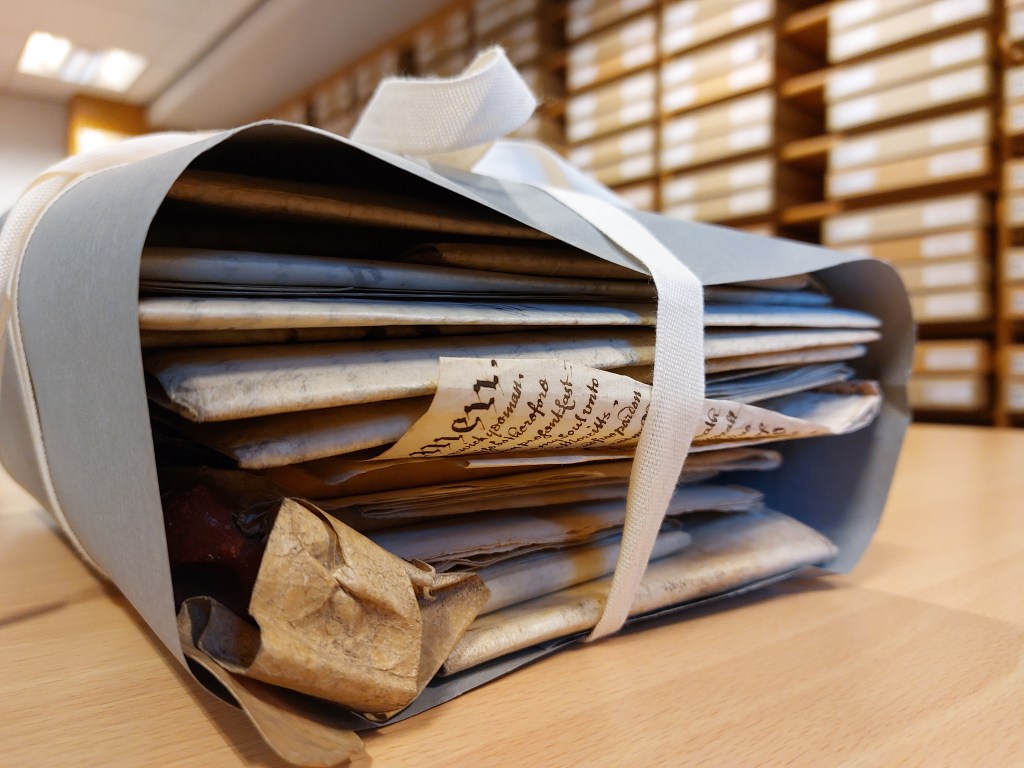
Of course, house histories alone do not a one-place study make – people are important too! One of the big obstacles to puzzling out the history of Oldnall End families and their homes is that the Berkswell Parish Registers have not survived before 1653. This requires a certain amount of creative thinking, and I’ve been fortunate this year to discover a range of name-rich 16th and 17th century sources that have helped to fill in some of the gaps and begin to match up people and properties. Some of my favourites are:
- Registers of the Guild of Knowle, 1451-1535. The Guild of St Anne was a prestigious religious and social organisation based in a neighbouring village. It attracted wealthy members from across Warwickshire and neighbouring counties, and its register, published in 1894, names many of Berkswell’s most prominent families such as the Acres, Bishops, Byssells, Higfords, Higginsons, Miles, Radfords, Savages and Sloughs.
- 1554 Survey of Berkswell. Taken for Queen Mary, who had repossessed Berkswell Manor from the executed John Dudley, Duke of Northumberland. Deciphering the heavily abbreviated Latin and super-swirly handwriting of Sir Clement Throckmorton of nearby Haseley is one of the hardest things I have done to date, but it was more than worth it. The Survey names more than 70 manorial tenants and describes their property and its location (I would love to track down Le Rawndetable!).
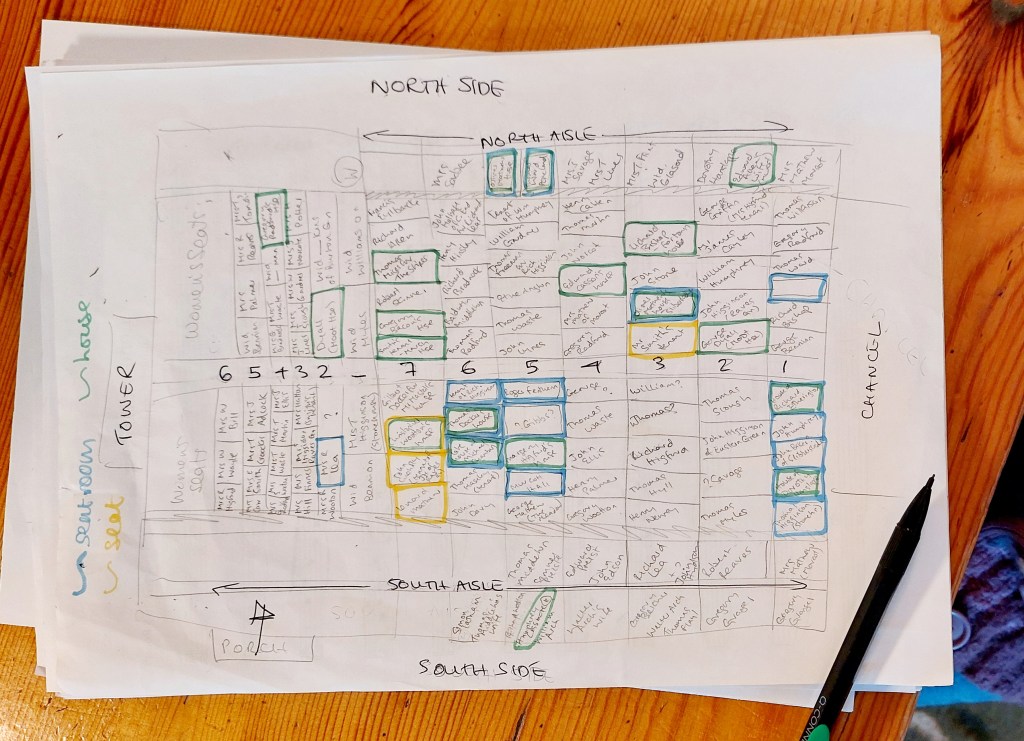
- 1611 Seating Plan of Berkswell Church. Copied out (upside-down) in the back of the first Parish Register (1653-1742), probably by Manuel Lugg, incumbent 1662-1710. Lists the seating positions of around 140 parishioners, sometimes with the name of their property (e.g. ‘Thomas Myles for a house called the Stripes’). It is undated, but the names suggest this is probably the same seat plan mentioned in the Churchwardens accounts for 1611. See my attempt to map it out above!
- Churchwardens Accounts, 1603-1617. Each year, Berkswell appointed two local men to serve as Churchwardens, who were largely responsible for running the Church. Their tasks included buying bread and wine for communion, organising laundry, collecting rents, paying the village schoolmaster, providing welfare payments, and representing the parish at the Bishop’s Visitation. Their biggest task, however, was Church maintenance – the accounts record frequent large payments to local men for tiles, nails, lime, lath, sand and labour. It’s a wonderful insight into a lot of mundane activity, but unfortunately, these are the only surviving C17 accounts for the parish.
- Civil War Loss Accounts, 1642-1646. This is a record of the financial and material losses suffered by Berkswell men (and one woman) during the Civil War. We’re lucky that the Warwickshire Accounts have been transcribed and made available by the County Record Office. The Berkswell accounts name 19 local men who found themselves hosting Parliamentary soldiers, and while I haven’t yet been able to match many of the names to properties, several were Oldnall End residents, including Henry Butler, Gilbert Docker, Thomas Hooke, Leonard Radford, Richard Reaves, and John Whitehead.
Record Keeping, or, the Sorcery of Spreadsheets
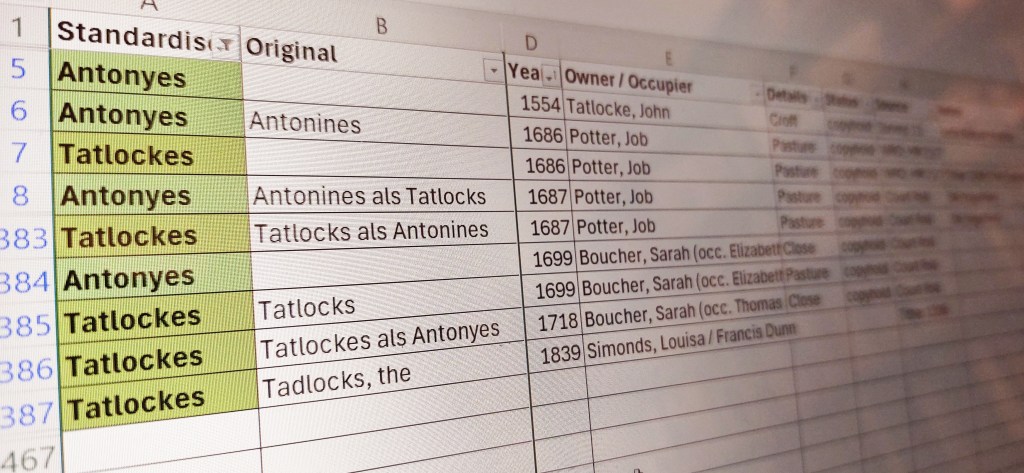
Collecting information from such a wide variety of non-standard genealogical sources is wonderful, but leads to a lot of unwieldy data. Because it’s so difficult to establish firm biographical data for Berkswell residents in the period before 1653, I set up a spreadsheet to record every mention of every person in every source before 1700. No, really. It’s now up to 3000 entries and it is a REVELATION as lives begin to emerge from the archival fragments, such as Alice Mathew (b.c. 1490), who married three times – first (c. 1510) to a Groom of Henry VIII’s bedchamber who was appointed Bailiff of Berkswell Park, then (c. 1555) to the owner of nearby Eastcote Hall, and finally (c. 1558) to her most recent father-in-law’s manservant.
A second spreadsheet, recording property names, field names, and other toponyms, is helping me to manage toponymic data from an equally wide variety of sources. The extract above gives a snapshot of my workings – this is the story of a copyhold field in Oldnall End that now lies beneath Lavender Hall Park, traced from the 1554 Survey to the 1839 Tithe Map via wills and Court Rolls. Figuring out that The Tadlocks (1839) was a corruption of (John) Tatlocke, who farmed the croft almost 300 years earlier, was definitely among this year’s top squeeeeeee! moments.
Cartography and Coloured Pencils
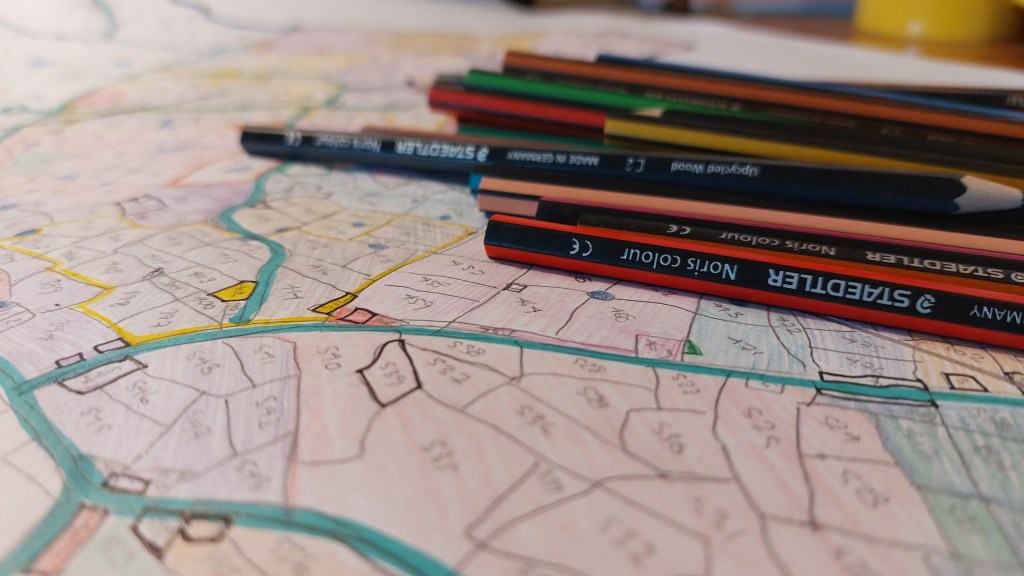
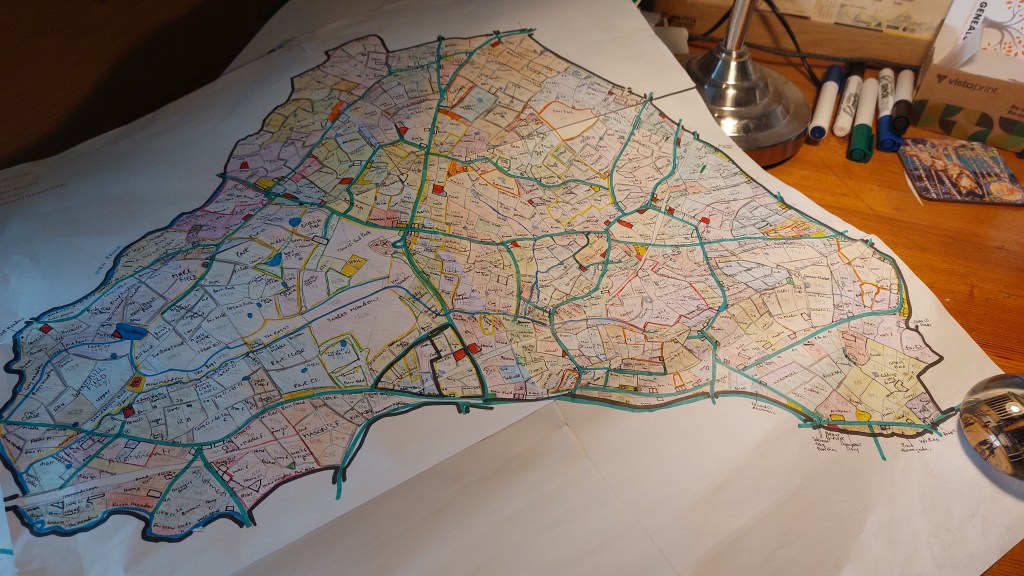
One unexpected discovery this year was that I really, really love drawing maps. I started small, sketching extracts from the Enclosure and Tithe maps, and ended up creating a detailed field map of the entire parish. I’m looking forward to creating illustrations for some of my ongoing projects during 2025.

On to 2025!
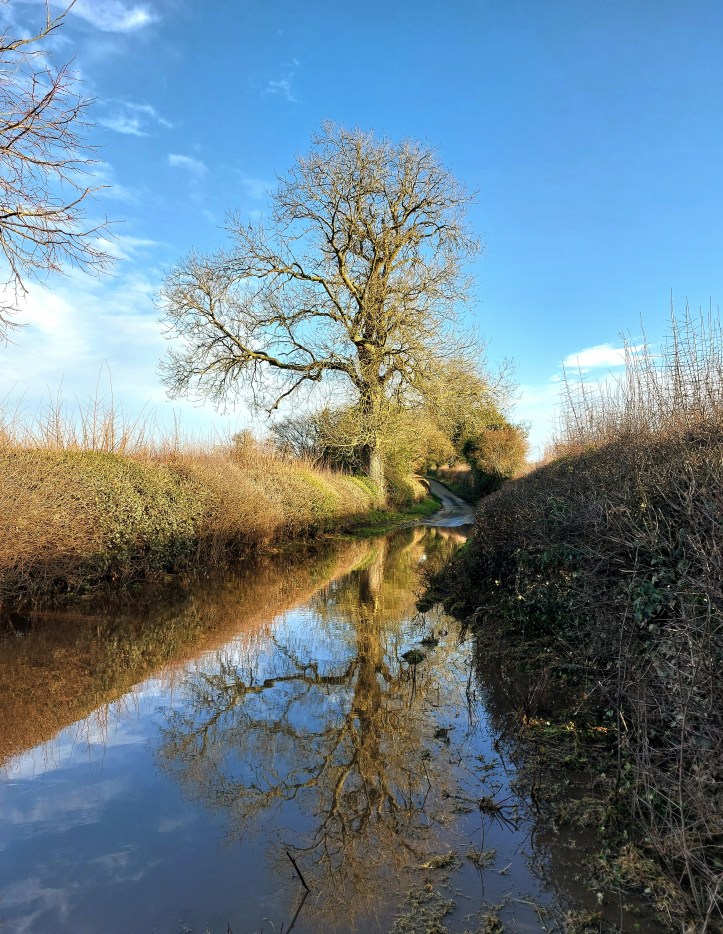
I have many plans for 2025, which include beginning to explore even older records, such as the Warwickshire Eyre Roll of 1262 and the Lay Subsidy Roll of 1332. I’m looking forward to a year of house histories, court rolls, probate inventories, field names, archives, hand-drawn maps, and lots and lots of walking. It’s thrilling to see the forgotten contours of Oldnall End begin to re-emerge , and I’m looking forward to sharing more stories, photos, drawings and reflections during the course of the next year. Onwards!
 Oldnall End One Place Study
No need to apologise.
Congratulations on your progress, I am impressed by the fabulous local resources you have uncovered and the number of house stories published.
Best wishes as you continue your journey of discovery.
LikeLike
Thank you so much!
LikeLiked by 1 person